
Organized with the IoT Students Club at University of Florida, we had a large diverse body of undergraduate and graduate students presenting posters and demonstrations on their research projects spanning various aspects of smart and connected systems. The student poster and demo session would be a great avenue to connect with our talented students.
Congratulations to our winners! We had 25 student demo and 80+ student poster presentations in the conference.
Student Demo Winners:
1st Place | F1Tenth Autonomous Driving Presented by: Christopher Oeltjen, Carson Sobolewski, Lorant Domokos, University of Florida Abstract: We will be demoing our f1tenth cars’ ability to drive around a non-predetermined track and map it out to create an optimal racing line and then follow that racing line. |   |
2nd Place | PLASMA: Platoon Security Against Multi-Channel Perception Adversaries Presented by: Chengwei Duan, University of Florida Abstract: A connected and autonomous vehicle (CAV) platoon constitutes a group of vehicles that coordinate their movements and operate as a single unit. The vehicle at the head sets a trajectory emulated by other following vehicles. CAV platoon is vulnerable to security attacks by adversaries that tamper the sensory or communication components of participating vehicles, resulting in the breakdown of coordination and consequently compromising the safety, stability, and efficiency of the platoon. In this paper, we develop a framework, PLASMA, to protect multi-vehicle CAV platoon against attacks on perception components of constituting vehicles. A unique feature of PLASMA is the ability to detect and mitigate adversarial activities in realtime, using a combination of kinematics and machine learning techniques. We perform extensive experiments to demonstrate the viability of PLASMA under diverse attack scenarios. Furthermore, a key outcome of our work is a disciplined analysis of various adversary models in CAV security and a methodology for systematic identification of mitigation techniques. |   |
3rd Place | Energy-Efficient, High-Security Body Area Network Enabled by Human Body Communication Presented by: Anyu Jiang, Asif Iftekhar Omi, University of Florida Abstract: Body Area Networks (BANs) are systems of interconnected devices designed to operate in, on, or around the human body, supporting a range of applications. These devices, including wearable sensors, implantable medical devices, and external monitoring units, communicate to collect, process, and transmit personal health data. Traditional BANs often rely on wireless communication technologies such as Bluetooth or Wi-Fi. However, two major drawbacks of using high-frequency wireless channels are: (1) operating at high frequencies results in significant energy consumption, and (2) signal leakage, extending up to approximately 5 meters outside the human body, compromises communication security.Noticed that these devices share a common channel: the human body itself. Due to its high water content, the human body can act as a conductor, enabling a wireline like communication. According to previous studies, compared to traditional RF communication, this communication technique has a 100 times better energy efficiency (reducing from the conventional 1 nJ/bit to sub-10 pJ/bit) and more than 30 times better security (reducing signal leakage from 5 meters to approximately 15 cm outside the body). This demo illustrates the concept of Human Body Communication by showing signals transmitted through the human body, which are visualized on an monitoring device. | 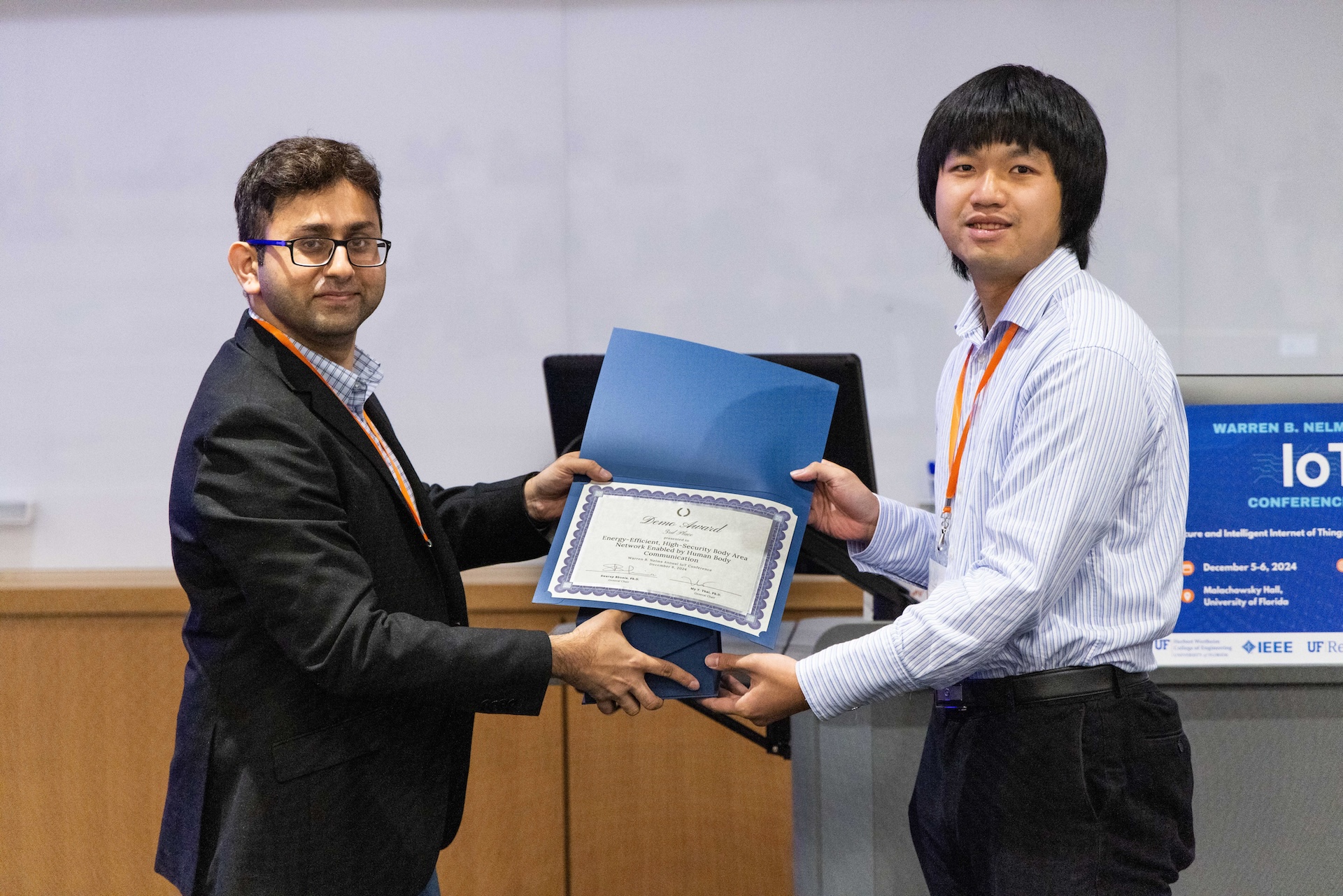  |
Honorable mention 1 | Exploring the Underwater Frontier with CavePI Presented by: Alankrit Gupta, Xianyao Li, University of Florida Abstract: CavePI is an underwater Remotely Operated Vehicle (ROV) designed for autonomous and semi-autonomous exploration of submerged cave environments. Equipped with dual cameras, sonar, a depth sensor, and a flight controller with an inbuilt IMU, CavePI is engineered to overcome the unique challenges of confined and low-visibility underwater spaces. The ROV’s primary capabilities include rope-following for navigation assistance, depth-hold for stable vertical positioning, yaw-hold for maintaining orientation, and precise movement along straight lines with controlled turns. These features enable CavePI to explore caves autonomously or with minimal operator input, making it an invaluable tool for scientific research, environmental monitoring, and geological surveying. |   |
Honorable mention 2 | Wearable Sensor System for Scapular Motion Monitoring Presented by: Junjun Huan, University of Florida Abstract: A wearable sensing system developed to monitor scapular movement in the human body during post-shoulder replacement surgery recovery. |  |
Honorable mention 3 | LATENT: Leveraging Automated Test Pattern Generation for Hardware Trojan Detection Presented by: Sudipta Paria, University of Florida Abstract: Due to the globalization of the semiconductor supply chain and the adoption of the zero trust model, hardware Trojan attacks pose significant security threats introduced by untrusted entities. Hardware Trojans involve malicious modifications to a design before fabrication, leading to unintended behaviors such as Denial of Service (DoS) attacks or leakage of sensitive information. Detecting these Trojans in fabricated chips is challenging due to the vast attack space. Conventional post-manufacturing Automatic Test Pattern Generation (ATPG) methods struggle with the activation (trigger) and observation (payload) of Trojans, making detection practically infeasible. While statistical testing techniques have been proposed for post-silicon Trojan detection, they suffer from limited trigger and payload coverage and scalability issues. In this demo, we show a scalable, payload-aware statistical test pattern generation framework, named LATENT that enhances Trojan detection by leveraging ATPG solutions. We show the performance of LATENT in detecting randomly inserted virtual Trojans using optimized patterns in open-source designs and demonstrate promising results for trigger and Trojan coverage. We also present the flexibility of the LATENT framework with configurable parameters like rareness threshold, N-detect, number of Trojans, etc. Additionally, we showcase the visualization of the hypergraphs generated from test designs and show the locality of triggers and payloads of inserted Trojans. |   |
Student Poster Winners:
1st Place | ML Model Extraction Attacks on IoT Devices: Strategies, Challenges and Defenses for Industry Applications Presented by: Tushar Nayan, Florida International University Abstract: The adoption of machine learning (ML) within the Internet of Things (IoT) ecosystem has transformed edge computing, enabling real-time intelligence in applications such as smart homes, healthcare, and autonomous systems. However, this shift introduces significant security risks. Adversaries can exploit ML models through attacks such as model extraction, leading to intellectual property theft, data privacy breaches, and operational failures in safety-critical IoT systems. Despite advancements, current defenses often fail in deployment due to scalability limitations, performance overheads, and IoT-specific constraints. We conducted an extensive evaluation of over 50 research projects, including 30 open-source works, systematically categorizing different threat models into application, device, communication, and model-based attacks and defenses. Filtering 16.5K real-world ML models from 210K Android application packages, we present the first comprehensive study of state-of-the-art model extraction attacks and defense and their practical limitations. We found that over 48% of real-world IoT models are vulnerable to naive app-based attacks, despite the availability of encryption-based defenses. Side channels and inference patterns highlight further vulnerabilities, to replicate models. Trusted Execution Environments (TEEs) is a potential defense solution but faces deployment barriers due to hardware dependencies and resource constraints. Moreover, energy demands of defense mechanisms remain prohibitive for resource-limited IoT devices. |  |
2nd Place | Zero-shot Safety Prediction for Autonomous Robots with Foundation World Models Presented by: Zhenjiang Mao, University of Florida Abstract: A world model creates a surrogate world to train a controller and predict safety violations by learning the internal dynamic model of systems. However, the existing world models rely solely on statistical learning of how observations change in response to actions, lacking precise quantification of how accurate the surrogate dynamics are, which poses a significant challenge in safety-critical systems. To address this challenge, we propose foundation world models that embed observations into meaningful and causally latent representations. This enables the surrogate dynamics to directly predict causal future states by leveraging a training-free large language model. In two common benchmarks, this novel model outperforms standard world models in the safety prediction task and has a performance comparable to supervised learning despite not using any data. We evaluate its performance with a more specialized and system-relevant metric by comparing estimated states instead of aggregating observation-wide error. |  |
3rd Place | Exploring the Underwater Frontier with CavePI Presented by: Xianyao Li, Alankrit Gupta, University of Florida Abstract: CavePI is an underwater Remotely Operated Vehicle (ROV) designed for autonomous and semi-autonomous exploration of submerged cave environments. Equipped with dual cameras, sonar, a depth sensor, and a flight controller with an inbuilt IMU, CavePI is engineered to overcome the unique challenges of confined and low-visibility underwater spaces. The ROV’s primary capabilities include rope-following for navigation assistance, depth-hold for stable vertical positioning, yaw-hold for maintaining orientation, and precise movement along straight lines with controlled turns. These features enable CavePI to explore caves autonomously or with minimal operator input, making it an invaluable tool for scientific research, environmental monitoring, and geological surveying. |  |
Honorable mention 1 | Enabling Decentralized Privacy-Preserving FL for Edge Computing Presented by: Richard Hernandez, Florida International University Abstract: Federated Learning (FL) has emerged as a promising approach for decentralized machine learning, but its reliance on a trusted aggregator presents significant privacy risks. We propose a novel FL framework leveraging Secure Multiparty Computation (MPC) to address these challenges and enable secure and privacy-preserving aggregation in untrusted environments. By incorporating the SPDZ protocol, our framework ensures that the aggregation process remains private, even in malicious environments. Unlike differential privacy-based methods, this approach preserves model accuracy while mitigating collusion risks among participants. Our system includes mechanisms to resist poisoning attacks by employing cosine similarity filtering on private models and a game-theoretic analysis to validate collusion resistance. Initial experiments demonstrate that the proposed framework achieves comparable accuracy to centralized FL training while maintaining robust security guarantees. This solution facilitates secure collaboration among edge devices, effectively integrating IoT data into training without exposing sensitive information. |  |
Honorable mention 2 | Language-Enhanced Latent Representations for Out-of-Distribution Detection in Autonomous Driving Presented by: Dong-You Jhong, University of Florida Abstract: Out-of-distribution (OOD) detection is essential in autonomous driving, to determine when learning-based components encounter unexpected inputs. Traditional detectors typically use encoder models with fixed settings, thus lacking effective human interaction capabilities. With the rise of large foundation models, multimodal inputs offer the possibility of taking human language as a latent representation, thus enabling language-defined OOD detection. In this paper, we use the cosine similarity of image and text representations encoded by the multimodal model CLIP as a new representation to improve the transparency and controllability of latent encodings used for visual anomaly detection. We compare our approach with existing pre-trained encoders that can only produce latent representations that are meaningless from the user’s standpoint. Our experiments on realistic driving data show that the language-based latent representation performs better than the traditional representation of the vision encoder and helps improve the detection performance when combined with standard representations. |  |
Honorable mention 3 | Bridging Dimensions: Confident Reachability for High-Dimensional Controllers Presented by: Yuang Geng, University of Florida Abstract: Autonomous systems are increasingly implemented using end-to-end learning-based controllers. Such controllers make decisions that are executed on the real system, with images as one of the primary sensing modalities. Deep neural networks form a fundamental building block of such controllers. Unfortunately, the existing neural-network verification tools do not scale to inputs with thousands of dimensions, especially when the individual inputs (such as pixels) are devoid of clear physical meaning. This paper takes a step towards connecting exhaustive closed-loop verification with high-dimensional controllers. Our key insight is that the behavior of a high-dimensional vision-based controller can be approximated with several low-dimensional controllers. To balance the approximation accuracy and verifiability of our low-dimensional controllers, we leverage the latest verification-aware knowledge distillation. Then, we inflate low-dimensional reachability results with statistical approximation errors, yielding a high-confidence reachability guarantee for the high-dimensional controller. |
List of Student Demos:
F1Tenth Autonomous DrivingPresented by: Christopher Oeltjen, Carson Sobolewski, Lorant Domokos |
Exploring the Underwater Frontier with CavePIPresented by: Alankrit Gupta, Xianyao Li, Md Jahidul Islam |
Underwater Scene Synthesis by Physics-Informed Waterbody FusionPresented by: Md Abu Bakr Siddique |
Visual navigation and exploration powered by on-device intelligence on a custom designed UAV platformPresented by: Yuxuan Zhang |
Microblaze FPGA DronePresented by: Wade Fortney |
Wireless sensor network implementation through remote access controlPresented by: Xi Wang |
Lightweight and Edge-Optimized Autonomous Driving Model on DonkeyCar PlatformPresented by: Dong-You Jhong, Zhenjiang Mao, Nathan Noronha, Mrinall Umasudhan, Cesar Valentin |
Autonomous RC Car Drift DetectionPresented by: Lorant Domokos, Christopher Oeltjen, Carson Sobolewski |
Innovative Assessment of Great Toe Strength Using ToeScale: A Portable IoT DevicePresented by: Raghuveer Chandrashekhar, Hongwu Wang |
Advancing Quantum Computing: Techniques for Efficiency and ScalabilityPresented by: Hoang Ngo |
Taming Thunder: Demonstrating HWIL Fuzzing on Cloud-Connected FirmwarePresented by: Austin Kee |
Baseline Clinical Characteristics and Machine Learning Predict tDCS Treatment Outcomes for AnxietyPresented by: Junfu Cheng, Ruogu Fang |
Uncoded Storage Coded Transmission Elastic Computing for Matrix-Matrix MultiplicationsPresented by: Xi Zhong |
Exploration of Immersive Virtual Environment for Automotive SecurityPresented by: Mustafa Mohammad Shaky |
MM-PUFPresented by: Peyman Dehghanzadeh |
Detecting Fake Honey Through Portable NMR SystemPresented by: Tianjun Wang, Rohan Reddy Kalavakonda, Kelsey Horace-Heron |
Wearable Sensor System for Scapular Motion MonitoringPresented by: Junjun Huan |
Targeted Fault Attack on DNN Accelerator Using Clock GlitchPresented by: Kazi Mejbaul Islam |
Energy-Efficient, High-Security Body Area Network Enabled by Human Body CommunicationPresented by: Anyu Jiang, Asif Iftekhar Omi |
CRISPPresented by: Atri Chatterjee |
Real-time Inferencing for Handwritten Character Detection from Neural Signals on a Portable Hardware DevicePresented by: Ovishake Sen |
Platforms for Engineering EducationPresented by: Rohan Reddy Kalavakonda |
PLASMA: Platoon Security Against Multi-Channel Perception AdversariesPresented by: Chengwei Duan |
LATENT: Leveraging Automated Test Pattern Generation for Hardware Trojan DetectionPresented by: Sudipta Paria |
A Neuro-Symbolic AI System for Autonomous ISR ApplicationsPresented by: William English |